Thứ Hai, 19 tháng 7, 2010

Skybax Maquette

In 1990 I constructed a reference maquette for the Quetzalcoatlus or “skybax” in Dinotopia.

If you’re thinking of making a maquette for a dragon or pterosaur, you might try some of these techniques.

I wanted to make this "hero" model to be fully posable so that I could position the wings in up and down flying positions. I also wanted to be able to fold up the wings so that I could imagine it perched on the ground.

It has a skeleton of aluminum armature wire running from head to tail and out through the wings. Toothpicks serve as wing bones, pipe cleaners as legs, and zigzagging floral wire support the wing. The head is made from a chunk of pine, with Sculpey bulking up the crest and eyes.

The neck is made from flexible squishy foam, allowing it to bend or twist. The prone rider is made from Sculpey, resting on a saddle glued together out of scraps of leather.

The wing membrane gave me the most trouble. My wife donated a pair of her old stockings, which I stretched over the wing bones and coated with a thin layer of latex. I added another layer of latex a few years later, but the wings got too thick and lost their elasticity.


The whole thing was knocked over several times by the cat. During one crash landing the rider lost an arm, so I replaced it with cardboard.
-----
Previously on GJ: Cellphone tour spotlighting "Skybax Rider" painting.

Chủ Nhật, 18 tháng 7, 2010

Influential Lion

The colossal lion from Nimrud was discovered by archaeologist Austen Henry Layard in 1849 and put on display in the British Museum.

The snarling muzzle and penetrating eyes apparently made an impression on English painter John William Waterhouse (1849-1917).

His 1887 painting “Mariamne” features a lion sculpture that seems to be influenced by the Nimrud lion.

The same Assyrian lion (and Waterhouse’s painting itself) must have influenced Edward John Poynter (1836–1919), who used lions of similar design to flank the royal stairway in his painting “The Visit of the Queen of Sheba to King Solomon,' 1890.
-----
I read about this in Elizabeth's Prettejohn's essay in "J.W. Waterhouse: The Modern PreRaphaelite"

Thứ Bảy, 17 tháng 7, 2010

Critix Redux

The recent post “Gérôme’s Critics” brought about 57 comments so far. It “touched a nerve,” as one of you said. One reader created a doctored version (below) of “Cave Canem” (Beware of Dog). It now says "Cave Arte" (Beware of Art). Thanks, C.!

I appreciate everyone’s contribution so far in the insightful, respectful, and wide-ranging discussion. Although Gérôme was certainly beloved by his students, his critical reputation has indeed taken an especially heavy hit in the last hundred years because of the stand he took against the Manet exhibition and the Caillebotte bequest. Even in his day he was suffering slings and arrows, which may explain the bitter edge of his attitude toward critics.

I don’t want my earlier blog post to imply that I necessarily share Gérôme’s feelings about art critics. Most of the ones I’ve met are remarkably open-minded, well-informed and articulate. They have their likes and dislikes, of course, but they don’t take orders from anyone on matters of taste. Let’s face it: Art criticism nowadays a tough business. It’s like walking in a minefield because matters of taste can be so contentious and polarized.

In the field of classical music, by contrast, most performers have to develop the skills to perform the entire repertoire. As a result, most music directors, conductors, performers and critics have a practiced familiarity with many way of making music, from Palestrina to Schoenberg. That breadth of exposure helps to mute the polemics.

In the visual realm, the term “Art” has been so thoroughly discombobulated that it can mean almost anything. (Still, it commonly leaves out so many things, such as comics, animation and illustration.) Our contemporary culture just doesn’t have any universally shared values on the subject, compared to a century and a half ago.

So what’s an art critic to do? How can you critique if there are no generally accepted standards? Is aesthetic relativism possible or desirable? What sort of negative criticism is most useful?

I’d be interested in your opinion. I would suggest that the art critic’s job is to encourage us to look closely at something outside our normal range of vision, something we’d be inclined to dismiss at first glance. The critic should beware of leveling the lance at an artist he or she dislikes, unless there is at least some sympathy with the artist’s purpose, some insight into technical processes, or a sharp satirical gift. Someone once said, “The best cure for bad art is good art.” To which I’d add: “The second best cure for bad art is to ignore it.”

That’s why I think Christopher Knight’s review fell short of what it could have accomplished. By merely disparaging Gérôme, Knight granted him underdog status and made him stronger. Nor did he offer any new insights to those who may have been inclined to appreciate Gérôme. I’d rather have read a tough critique of Gérôme by an accomplished realist painter who started with more sympathy for Gérôme’s basic approach.

To that end, let me recommend some art blogs that do a good job of bringing attention and insight to all sorts of Art, though many of the authors would not consider themselves critics.

Underpaintings by Matthew Innis. Good roundup of current museum exhibits.
Illustration Art by David Apatoff. Currently a fascinating debates (with 162 comments) on the use of photography.
Lines and Colors by Charley Parker. Survey and bios of artists in many fields.
Life in the Studio by Jay Fullmer . A new blog, which started with a post about photographing in museums to get accurate color (Jay's image above).
Art and Influence by Armand Cabrera. Profiles of past masters, advice on business and contemporary working methods.
Bearded Roman by Micah Christensen. Deep insights into academic masters
Howard Pyle blog by Ian Schoenherr. A passionate collector of Pyle papers and expert on his life.
Stapleton Kearns Wide ranging painting insights from a master landscapist.
-----
GJ Post "Gerome's Critics"
The LA Times review of the Gérôme exhibit at the Getty Museum. Read down to the comments at the bottom, where Christopher Knight retorts: "[French] Academics looked to the Royal Academy for approval; Modern artists looked to themselves and their cohorts for approval; and Gerome, having neither the Academy nor the new artists on his side, turned to the general public, who liked what they saw." Huh?
--------
L.A. Times reviewer Christopher Knight (aka "Culture Monster") launches a fresh attack on Gerome in "The Strangest Roomful of Art in LA Right Now"

Thứ Sáu, 16 tháng 7, 2010

Norton Museum Video


Glenn Tomlinson of the Norton Museum of Art introduces the Dinotopia exhibition in this video.

Norton Museum website
For potential museum venues inquiring about possibly hosting the Dinotopia show, please contact Mary Melius at the Norman Rockwell Museum at mmelius (at) nrm.org

BTW, anyone know how I can keep from clipping the right side of the videos when they post? (Later: fixed! Thanks, Mike, Christopher, and SuperVillain)

Monkey King

I’m honored and grateful to receive the Monkey King award from CICAF, the annual animation festival in Hangzhou, China.


The painting that won the award is “Desert Crossing,” from Dinotopia: Journey to Chandara.

Next time I visit a troupe of wild monkeys, I will now demand respect as their true sovereign. I will not tolerate the lèse-majesté that happened on the previous occasion.
------
CICAF's Monkey King Award
Journey to Chandara
GJ Post: "Manhandled by Apes" and "Return Flight"

Thứ Năm, 15 tháng 7, 2010

Indigo Fading

“Bridge With Mountains” is a watercolor from J.M.W. Turner’s Cyfarthfa sketchbook.

It was on exhibition until 1905, when someone noticed that everything but the part covered by the frame had turned brown.

What happened to the blue? The same indigo that dyes blue jeans was used as a pigment, and it either faded or shifted under strong light.
------
from Turner's Early Sketchbooks, by Gerald Wilkinson

Thứ Tư, 14 tháng 7, 2010

Realistic Dinosaur Suits

Stout’s Hallucinations

Flesk Publishing has just released a new collection of artwork by William Stout called “Hallucinations.”

This is the first of two 48-page softbound collections of Stout’s watercolor and ink artwork. The subjects include dragons, genies, and witches, as well as scenes from Oz and Aesop. The penwork is ornate, intricate, and sometimes whimsical, with smaller details and subordinate characters adding levels of fascination to the pictures.

In the introduction, Stout credits the inspiration that he draws from the early 20th century children’s book illustrators, especially Edmund Dulac, Arthur Rackham, John Bauer, and William Heath Robinson.

This is the first of a two related volumes. The next one will feature women and wonders, and will be called “Inspirations.”

There is also a signed hardbound edition, limited to 500 copies, which is almost sold out.

Flesk Publications

William Stout official site.

Thứ Ba, 13 tháng 7, 2010

Totentanz

Totentanz is the German term for a dance of death, often portrayed in late medieval art. The French call it danse macabre.

Above: “The Dance of Death” (1493) by Michael Wolgemut. Skeletons leap up from graves, play instruments and give each other high fives, with their tattered shrouds still wrapped around their shoulders.

This one is by Bernt Notke (click on image to enlarge). The skeletons alternate with popes, kings, artisans and commoners, arranged by rank. Death conquers and equalizes all social classes.


The skeletons are livelier than the living, kicking their heels in the air. The theme got a big boost with the Black Death from plague in the 14th century and from the slaughter of the Hundred Years’ War (1337-1453) between France and England.

The theme has turned up in many art forms, starting with poems, mime dances, and morality plays. Nineteenth century composer Camille Saint-Saëns wrote piece of music called “Danse Macabre” which sets the scene perfectly, with the xylophone playing the bones.

Saint-Saens performed on orchestra via YouTube
Note: Lots of links in the comments.

Thứ Hai, 12 tháng 7, 2010

A. Wyeth at the Hyde Collecton

Today would have been Andrew Wyeth's 93rd birthday.

In celebration of his work, the Hyde Collection of Glens Falls, New York, is hosting an exhibition called "Andrew Wyeth: An American Legend," consisting of about 45 drawings, watercolors and egg temperas.


The exhibition closes September 5.
Hyde Collection Wyeth exhibit
Image "Long and Limb," 1999, from New York history blog,
which has more info about the show.

Chủ Nhật, 11 tháng 7, 2010

Hofner Copy

A great way to get to know a painting is to do a little copy of it.

The original painting is called “The Little Shepherdess,” by Johann Baptist Hofner, painted in 1866.

The copy is in oil, four by six inches using a #2 bristle filbert. I chose the relatively big brush because I wanted to interpret the larger masses, not the tiny details—for example the head as a unit, not the individual features.

The poster reproduction I worked from had a different color atmosphere than this Internet picture. If you’re working from print or screen reproduction, try to gather four or five versions and then you can make a closer guess what the real painting looks like.

Thứ Bảy, 10 tháng 7, 2010

Making Gargoyles

There are at least two ways to make a gargoyle: Carve it or sculpt it.

I carved this one out of poplar wood for the end of the handrail in the stairway to my studio. Poplar splits easily and I messed up on the other side---which is why I put the bad side to the wall.

But there’s an easier way if the piece is only decorative. You can sculpt the head out of the air-drying foam called “Model Magic,” and then paint it with acrylic to simulate wood grain. The whole process only takes a couple of hours.

That’s how Jeanette and I did the green men that live on the keystones of the arches over the studio windows.

Thứ Sáu, 9 tháng 7, 2010

Gérôme’s Critics

Los Angeles Times art critic Christopher Knight gives the “thumbs down” to academic painter Jean-Leon Gérôme (1824-1904), who is featured in a large exhibition currently at the Getty Museum.

Knight dismisses Gérôme as a “populist painter” who “didn’t have a clue,” and who indulged in “sword-and-sandal melodramas.” He argues that he failed the Prix de Rome competition through lack of drawing ability, later selling out to commercial considerations.

According to Knight, “every artist we revere today was on the other side” of Gérôme and that he failed because he “disengaged with art’s possibilities” by limiting his artwork to mere illusionism.

Although Gérôme’s artwork is not above criticism, Mr. Knight’s assessment is regrettably narrow and unfair.

The documentary evidence from writers of Gérôme’s own day paints a more sympathetic and nuanced portrait of the man and his art.

Gérôme was genuinely respected by critics his day, and by his students, even many who pursued an impressionist approach to painting. He was admired not just for his ability as an artist, but for the breadth of his artistic vision.

Consider the following:

“Gérôme remains at sixty years of age the same as he was at thirty-six: as youthful, vigorous, active, and wiry; full of life and sympathetic. An agreeable, gay talker, pensive notwithstanding his good humor, respectful of his art, frank and loyal, adored by his pupils, he is the professor who teaches the young those rare and neglected virtues: simplicity, study, and labor. In a word he is a noble example of what a master-painter of the nineteenth century may be: an artistic soul with a soldier’s temperament, a heart of gold in an iron body.”

--French critic Jules Claretie, quoted in Nancy Douglas Bowditch, George de Forest Brush: Recollections of a Joyous Painter.

“I cannot but esteem him as one of the masters and most distinguished men of his age.”
--J. Alden Weir, “Open Letters.”

“As a teacher he is very dignified and apparently cold, but really most kind and soft-hearted, giving his foreign pupils every attention. In his teaching he avoids anything like recipes for painting; he constantly points out truths of nature and teaches that art can be attained only through increased perception and not by processes. But he pleads constantly with his pupils to understand that although absolute fidelity to nature must be ever in mind, yet if they do not at last make imitation serve expression, they will end as they began—only children.”

--George de Forest Brush, in “Open Letters: American Artists on Gerome,” Century magazine, February 1889.

“Oblivious to methods, seeking to develop each pupil’s peculiarities and temperament, he frowned upon any attempt to follow in his ways unless he thought it entirely within the sympathies of the pupil.”
--Wyatt Eaton, “Open Letters.”

Let us allow Mr. Gérôme to rise from the grave and answer Mr. Knight with his own words: “As to the self-styled critics, their approbation and their raillery have always found me indifferent, for I have always had the most profound contempt for these ignorant vermin, who prey upon the bodies of artists.…These art critics, whose ignorance is often deplorable,—quite encyclopædic in fact,—who have not learned the a b c of our profession, consider themselves fully competent to criticize it.”
-- Gérôme quoted in Century magazine, February, 1889, page 488 and 495.

The exhibition “The Spectacular Art of Jean-Léon Gérôme will remain on view at the Getty Museum in West Los Angeles through September 12, 2010. The first exhibit of its kind in nearly 40 years, it contains 99 works by Gérôme and his contemporaries.

LA Times review.
Getty museum website
Century magazine archives
Jean Leon Gerome.org (big database of image)
Thanks, Dave!

Thứ Năm, 8 tháng 7, 2010

The Flying Car

The flying car was a main theme of yesterday’s dreams of the future.

The requirements: it must fit in the garage, drive on a road, take off in a small space, and fly on its own power without adding or subtracting any parts.

Finally, there’s a prototype that seems to meet the test. Now we’ve just got to figure out how to deal with air traffic.

Cover image from PopSci.com “Dude: Where’s my Flying Car?”
Video via Best of YouTube
YouTube video

Thứ Tư, 7 tháng 7, 2010

Cellphone Tour

Here’s a fun way that you can experience the Dinotopia exhibition that’s now in West Palm Beach, Florida.


In the back of one of the exhibition rooms is a painting called “Skybax Rider.”

If you have a telephone handy, dial the following number, and you can hear me in your ear talking about it. Dial 561-515-4185. Then hit extension #4.
------
Tour hosted by OnCell systems
"Dinotopia: The Fantastical Art of James Gurney" at the Norton Museum of Art

Thứ Ba, 6 tháng 7, 2010

How to Refill a Fountain Pen

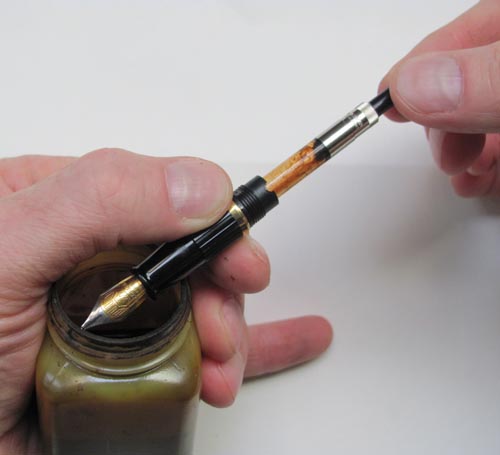
Some Waterman fountain pens come with a refillable cartridge.

By submerging the end of the cartridge into a bottle of water-soluble ink and twisting the little knob, a piston will draw the ink up into the cartridge. This way you can use whatever color of ink you want, such as a brown or gray.

Gray and brown are no longer generally available as standard disposable cartridge colors in Waterman pens. But it must be water-soluble ink formulated for fountain pens, not India ink.


You can refill any fountain pen, even if it doesn’t have one of those special refillable cartridges. A hypodermic needle works perfectly for injecting ink into spent cartridges. Here I’m refilling a Schaeffer calligraphy pen.

I got my hypodermic needle in a kit for refilling printer cartridges.
------
Step by step from Instructables, using different tools.

Color Correcting

The last few days I’ve been color-correcting my upcoming book. Since the subject is “color and light,” my publishers and I want to get it as accurate as we can.

Each of the 270 or so separate color illustrations has to be checked and marked up on the press proofs.

Fortunately we have most of the original art available for comparison. This painting, called “Doorway to Mystery,” was first published in Dinotopia: The World Beneath, a copy of which lies open next to the page proof. The blue-greens of that water are especially hard to capture.

Thứ Hai, 5 tháng 7, 2010

Cadaver on the Cross

Academic master Léon Bonnat (1833-1922) spared no effort to inject realism into his painting of the crucifixion, commissioned for the Palais de Justice and completed in 1874.

According to one of his American students, J. Alden Weir,
“I went into the dissection room and saw Mr. Bonnat with the Prof. [Gerome]. They had just received a subject, and a the opposite side of the room I saw an immense cross, but thought nothing. Bonnat said he had not much time to stay and wanted the gendarme to hurry up so two of these soldiers and a hired man took the subject out of the room, brought the cross out and laid it on it.

It was then whispered about that Bonnat had a commission to paint a crucifixion, had bought the subject, and had the cross fixed, so as to be able to study the action of the muscles. Some of the students, hearing what was up, crowded in; this attracted Bonnat’s attention, and he got the gendarme to close the door and lock it.

We went back to the lecture room where we draw the bones, and while sitting there we heard the nails driven in. We finished; Mr. Blackman and myself went out together after all had gone.

At the door we met a guardian and bribed him to let us see the subject, which he did, and standing up against the wall was the large cross with the subject crucified on it, a horrid sight; but it shows how these French artists believe in truth.”


--from The Lure of Paris: Nineteenth-Century American Painters and Their French Teachers, by H. Barbara Weinberg

Chủ Nhật, 4 tháng 7, 2010

Officer K. Kong

When I was in college I made a gorilla mask out of cast latex. It had a separate jaw with teeth cast out of fiberglass resin. I put black makeup around my eyes, so you couldn’t see the edge of the mask.

Around the same time I bought a security guard uniform at a thrift store. Walking around as an Ape-Cop gave me a little authority in my run-down neighborhood.

I joined the Fourth of July parade as an ape on a unicycle. I also rode that way around the campus of the University of California at Berkeley, where I was an anthropology major.
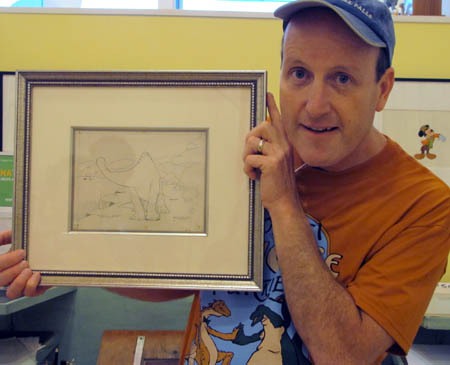
The gorilla mask proved useful during the final exam of my primate social behavior class. All through the semester, the professor had made a big point of proving that gorillas are really gentle, intelligent creatures, not aggressive monsters.

I arrived on day of the final exam day carrying the head and hands of the gorilla concealed in a paper bag. I sat in the back row.

Somehow I finished the test about 20 minutes early. I quietly pulled on the mask and gloves. I stood up and started down the aisle gripping my papers. With a growl and a little table-pounding in the front of the room, I handed in my exam to the professor.

Then I turned to the class, put my fists in the air and hit my chest a few times and marched out the door.

It must have taken a few minutes for the class to refocus.

Thứ Bảy, 3 tháng 7, 2010

Arnold Friberg Dies at 96

Utah artist Arnold Friberg, painter of historical scenes of Washington at Valley Forge for the U.S. Bicentennial in 1976, died Thursday at age 96.

He was known for a range of historical subjects, including images of the Royal Canadian Mounted Police, marketing art for the film "Ten Commandments" and paintings for the Church of Latter-day Saints. (Correction: The Church of Jesus Christ of Latter Day Saints. Thanks, Les!)

More samples of his work can be seen at the blog of Greg Newbold, who had the chance to meet him.
AP Friberg Obit

Rising Stars Search

ImagineFX magazine recently launched a campaign to discover, promote and celebrate the best young sci-fi and fantasy artists and illustrators, whether digital or traditionally based. If you're interested, the deadline is Monday.


“If you’re 25 or under, have a burning desire to be the best in your field, whether you’re working as an artist, a student or just want to share your art with the world, everyone is welcome. International entrants are welcome and there’s no charge for entry.

“Entrants are invited to submit five pieces of portfolio work and a short biography, sent to: imaginefx@futurenet.com. The deadline for all entries is 5 July, 2010.”


Photo by J.Gurney at the 2010 Illustration Master Class.
---from the ImagineFX press release.

Thứ Sáu, 2 tháng 7, 2010

Draperyman

The draperyman was a specialist who assisted portrait painters in the 18th and 19th centuries in the design and rendering of costume accessories. Below: King George III in coronation robes by Allan Ramsay (1713–1784).

Draperymen had a knack for painting velvet, lace, satin, and silk, doing so in the style of their clients. Sometimes the portrait artist would paint only the head and hands and then send the canvas to the draperyman for finishing.

One of the most prominent among them was the Flemish-born Joseph van Aken, who assisted Allan Ramsay and Sir Joshua Reynolds. So much was van Aken depended upon, that after his death in 1749, William Hogarth made a satirical drawing showing his distressed clients dolefully following his coffin.

Draperyman at Encyclopedia.com

Thứ Năm, 1 tháng 7, 2010

Undertones and Tints

Pigments can be rated according to their transparency or opacity. A good way to test your paints is to spread a thick layer, called a masstone, across a white gessoed surface (far left swatch).

Next to that, spread a thin, transparent film, called an undertone (swatches 2 and 3). A dark mark on the board behind the film of paint helps to test opacity.

The colors in these swatches are ultramarine blue, Venetian Red, and terre verte. The Venetian red is the most opaque of these three.

You can also test the pigment’s tinting strength by adding white. Tinting strength refers to the ability of a pigment to maintain chroma with the addition of white (remaining swatches). Some colors, like pthalo blue are powerful in tints. Some, like terre verte are relatively weak.

Most colors shift a bit in their color temperature. Warm colors typically shift to the cooler or bluer side.

Thứ Tư, 30 tháng 6, 2010

Smiling Presidents

American presidents started smiling for their official portraits in the mid 1970s or so.


Of course, they smiled for informal pictures before that.

Many cameras captured FDR with his famous smile. Rockwell painted Eisenhower for two Post covers in a rubbery grin. Jimmy Carter’s toothy smile was a big subject during his campaign.

But for the official and semi-official pictures, up until 30 or 40 years ago, presidents usually kept their faces dignified and serious. After Reagan, the full-on toothy smile (which is a very different challenge to paint) was here to stay.

Why the change? Was it the inevitable outcome of photography or was it the result of campaigning on television?

Are there other jobs that still demand a serious portrait, such as a Supreme Court justice, district attorney, or an undertaker?

Thứ Ba, 29 tháng 6, 2010

Akira at the Toonseum


Toonseum is a new museum of cartoon art in Pittsburgh, Pennsylvania. It is currently hosting an exhibition of art from the animated film Akira.

Akira, set in twenty-first-century post-World War III Japan, was directed by comic artist Katsuhiro Otomo. Released in the USA in 1990, Akira was one of the last feature films created with traditional hand-painted cel and painted background technique.

On display are stunning perspective layout drawings and renderings of science fiction cityscapes, as well as effects animation cels and character designs. All of the art comes from the collection of Joe Peacock.

Toonseum is one of only two museums in the USA dedicated exclusively to art from the comic strip, graphic novel, comic book, and animated film. Earlier museums in Rye, New York; Boca Raton, Florida; and Northampton, Massachusetts are sadly no longer in operation.

Toonseum is very small—the size of a gallery or shopfront, but it’s fun to visit because it’s run by artists. They encourage you to sit down and draw on an actual worktable from one of Disney’s early animators.

They even granted me the geek dream of holding an original drawing from “Gertie the Dinosaur” by Winsor McCay.


And they talked me into doodling on the hall-of-fame group sketch.

Toonseum is located at 945 Liberty Avenue, Pittsburgh, PA. It’s open from 9 to 3 on most days, Wednesday through Sunday. The Akira exhibit will be on view through July 18.

Toonseum.org

Hours and admission


YouTube interview with Akira creator Katsuhiro Otomo

Thứ Hai, 28 tháng 6, 2010

Griffin Portrait

Until yesterday, I had never painted a living griffin before.

A magnificent specimen named China Blue Rockett posed for me during my hour-long demo on water-soluble colored pencils at Anthrocon.

I used an assortment of Caran d'Ache Supracolor 2 pencils. After a light lay-in, I scumbled a few colors and dissolved them with three Niji water brushes: one filled with clear water, another with a middle gray (the strokes on the sleeve), and another with black.

By juggling the water brushes, I kept the edge around the head soft, so as to suggest the fringe of fur without painting every hair.
------
Anthrocon aka Furrycon
More on GJ on that colored pencil technique
Wiki on Griffins (or if you prefer the spelling: griffon, gryphon, γρύφων, grýphōn,, γρύπων, or grýpōn).

Chủ Nhật, 27 tháng 6, 2010

Castle of the Maidens

In 1901, American expatriate artist Edwin Austin Abbey unveiled his mural epic "The Quest and Achievement of the Holy Grail" for the Boston Public Library.


One of the panels shows the following, according to the official text:

"Sir Galahad's entry into the Castle is here shown.
The imprisoned maidens have long been expecting him,
for it had been prophesied that the perfect knight would
come to deliver them. They welcome him with shy
delight, putting out their hands to be kissed; behind
him lies his white shield bearing the red cross painted
with his own blood by Josephes, son of Joseph of
Arimathea. Having accomplished this mission, Sir
Galahad passed on to other deeds."

-----
The murals have been restored and are open to the public.
Boston Public Library website info.
Full text explaining murals
More about Abbey from BPIB
Abbey on Wiki

Thứ Bảy, 26 tháng 6, 2010

What Are Furries?

Furry fans are people who are interested in anthropomorphic animals, especially cartoon characters. Most furries strongly identify with a particular non-human animal species.

Furry identities are called fursonas. They include dragon, feline (cat, lion, tiger), and canine (wolf, fox, domestic dog) species.

Some furries blend species, such as a cabbit (cat and rabbit) or a folf (fox and wolf). A few furries identify with monkeys or apes.

The largest furry convention is called Anthrocon, also known as Furriecon, which is being held right now in Pittsburgh, Pennsylvania. This year the theme is “Modern Stone-Age Furries.” Some dinosaur-based costumes have been made specially for this Anthrocon.

During the rest of the year, furries meet in cyberspace to compare notes on costume building and to share artwork depicting anthropomorphized animals.

While attending Furry Fandom conventions, some furries dress head-to-toe in animal-like costumes, referred to as fursuits. Fursuits, similar to what athletic team mascots wear, are constructed of fabric, not fur or animal skins.

While in a fursuit, a furry walks upright. Some furries superimpose human clothing on the fursuit; for example, a snow leopard diva may wear a red cocktail dress and a big yellow dog may wear blue jeans.

Most furries do not own a full fursuit because they are costly. Many furries wear a partial fursuit consisting of ears and a tail.

The preceding was adapted from anthrocon.org, the official website for furry fandom.


This year’s convention has approximately 4000 attendees, the largest furry convention in the world, and the largest of all time.

It features a dealer’s room and art show, much like a science fiction convention, a track of programming that today included a puppet performance workshop by guest Jim Martin of the Muppets, a video game contest, card and role playing games, three different dance events, and a quiet art room for artists doing custom commissions.

I would just add that furry fans are some of the nicest and most creative people I’ve met at any sort of convention, and I’ve never been received more graciously or generously as a guest at any con before. The whole group conveys a spirit of acceptance and childlike fun.
------
Anthrocon.org
Furry Artwork at Furaffinity.net
Wikipedia on Furry Fandom
Article in today's Pittsburgh Post Gazette