Thứ Tư, 18 tháng 8, 2010

Portraitist’s Dilemma


A cartoon of John Singer Sargent from 1917.

"Here's Sargent doing the Duchess X
In pink velours and pea-green checks.
'It helps,' says he, 'to lift your Grace
A bit above the commonplace.'"

From "Confessions of a Caricaturist," by Oliver Herford. Available for download from Google Books.

Thứ Ba, 17 tháng 8, 2010

Gamestoppers

Here’s a scene that I really wanted to paint in Bantry, Ireland last week. The green and red building stands at the juncture of two sloping roads in town.

But it was impossible to paint the scene on location for a simple reason: The only place to set my stool was a busy sidewalk that was only two feet wide.

Because the road was so narrow, and because it was the main thoroughfare for the coastal route out of Bantry, huge trucks were forced ride up onto the sidewalks to allow other vehicles to pass.

There was a real risk of being clipped by a rear-view mirror, and I didn’t want to force pedestrians to step into the street. So I had to give it up and look for another motif.

I call such an impediment a “gamestopper.” It’s something that shuts down a plein-air effort, and it has nothing to do with issues of technique or composition.

I’ll list some other examples, and I’m sure you’ll have more in the comments. Every one of these has happened to me:

1. Menaced by bull in the middle of a field.
2. Heavy downpour starts (fatal to watercolor) and wind blows rain under umbrella (eventually shuts down oil painting).
3. Forgot the chair, and no place to sit down.
4. High wind makes easel impossible to set up.
5. Subject (person, vehicle, animal) departs.
6. Drunk guy in bar keeps bumping hard into sketching arm.
7. Tide comes in, eliminating setup area.
8. Donkey puts head in lap.
9. Sketching from drawbridge; drawbridge lifts.
10. Goats keeps nibbling sketchbook.
11. Kicked out by guard/ harbormaster/ cop/ farmer/ railyard bull—and once ejected by a nun!
12. Easel blown over washed down waterfall.
13. Scheduled steam train (my ride home) must depart.
14. Folding chair collapses in museum.
15. Biting insects become too unbearable.
16. Unseen people on overlook above keep spitting on me.
17. Forgot key supplies (brushes, solvent, paints, or panel).
18. Fog comes in and covers view.
19. Shop opens or doorway becomes active.
20. Sub-freezing temperatures freeze watercolor.
21. Automatic sprinklers turned on in garden.
22. Car or truck parks in front, obstructing view.
23. Lights turned on, killing mood; or turned off, obscuring sketchbook.
24. Tour bus unloads gaggle of annoying tourists who hover around snapping pictures and asking inane questions.
25. Portrait subject approached, waving a finger, superstitious about being drawn.

Chủ Nhật, 15 tháng 8, 2010

Last Day in Ireland

Yesterday was our last full day in Ireland, and we drove all around west Clare.

I did this little sketch while having a cup of tea at an outdoor cafe in Ennis.

This is my fourth trip to Ireland. The first was 16 years ago. We revisited some of the same places we were acquainted with before, and they haven’t changed too much, other than a small “suburban-style” development on the fringes, a cell tower here and there, and a few new windfarms.

We had heard all about the boom and bust of the Irish economy since our last visit, but compared to New York state, the roads were in better shape, and there were fewer closed businesses. And the people are just as charming and warm as ever.

I’ll close with a line we read somewhere: “May the roof of your house never fall in, and those within it never fall out.”

Two-Handed Quick Draw

Here's a guy who draws simultaneously with two hands on a dry-erase board and then erases. It's in real time, judging from the birds and pedestrians.

It makes my attempts at two-handed drawing seem pretty lame.

Via Best of You Tube

Thứ Bảy, 14 tháng 8, 2010

Ridiculous Car Hoods


Over at Huffington Post, they've got a photo gallery of the most ridiculous car hoods of all time, and you can vote your favorite.

Maughansilly Basket Maker

We got lost on the one-lane farm roads trying to find the row of megalithic stones near Maughansilly, County Cork. A little sign that said “Visitors Welcome” beckoned us up a dirt driveway.

We stopped in the middle of a farmyard inhabited by chickens, turkeys, ducks, geese, and a teenager with a weed whacker. Bunches of willow withys were soaking in metal troughs. A man hailed us from inside the open doorway of a stone barn, where he sat inside making baskets.

I sketched a quick portrait as we talked. His name is Martin O’Flynn. He is one of only ten master basket makers in all of Ireland. The knowledge almost died out in the 1980s, when cheap plastic ware came in, but he was able to learn from a few of the older men.

IF YOU GO
If you’d like to meet Martin and Yvon and see their handmade baskets, just drive up the Coomhola River from Ballylickey and head over on the single lane road toward Carriganass Castle, or follow the road up the mountains from Kealkill. Don’t try to drive up the path from Dromduff unless you have high ground clearance.

Martin O'Flynn Baskets

Thứ Năm, 12 tháng 8, 2010

Irish Signs

Most shop fronts in Ireland still have hand-painted signs.

John Herrick’s sign shop in Galway is down an alley next door to an instrument maker. Like most sign painters, he is also an artist and he offers art lessons.

Ma Murphy’s pub in Bantry shows the architectural setting—a fairly typical Irish facade, framed with pilasters, scroll corbels, and a dentillated cornice.

Curving baselines, shadow lettering, and Nouveau flourishes give distinctive touches set this sign apart from cheap computer-generated plastic signs.

The illusion of dimensional lettering on a flat surface is often created with five premixed tones: light side, shadow side, dark accent, highlight, and cast shadow. Such work takes specialized brushes and brush skills, and it’s a dying art in many other countries.
---------
Previously: Hand-Painted Signs (mostly North African).
There are several Flickr groups devoted to this subject:
“Hand-Painted Signs of the World.”
“Folk Typography”
“Signpaintr,” dedicated to the lost art of hand-lettering
“Hand-Painted Signs of Cambodia.”

Scart Road

Yesterday we set up our folding stools at the top of Scart Road looking down into Bantry, Ireland. Occasional sprinkles of rain and gusts of wind gave us some trouble: At one point the wind knocked over my water cup and dumped three ounces of water all over the half-finished watercolor.

The thing I found the most challenging was the perspective drawing. Here’s the scene as it looked to the camera. I knew all those buildings have different vanishing points from each other. And the road has its own set of vanishing points below eye level. And I expected I would be tricked by those building fronts, which were extremely foreshortened.

But even knowing all that, I still had to erase and redraw the pencil drawing three times until I was convinced I had it right.

Here’s how the line drawing looked after about three hours of measuring, erasing, and redrawing. I used a regular #2 pencil and I didn’t use straightedges. I tried to pin down some measurements using the central pole as a fixed unit of length.

Just to remind myself how much I need to improve, here’s the line drawing superimposed over the photo, after the fact. I made the yellow building on the right too big, and misplaced the windows and doors on the gray building on the far left. What would have cured a lot of these errors would be to measure across the scene, holding up a level pencil in front of me to judge relative heights—and I’ll do that next time.

Here’s the final painting, after two sittings on location, and about five hours work. I did make a few conscious changes, such as eliminating the wires, and raising the value of the illuminated roof on the red building in the middle distance.

And I regrettably left out of the drawing the wonderful people of Bantry, who passed by with a friendly hello while we were working—especially Brendy, who lives in the house at the far left.

“I like to say hi to me neighbors,” he said to us. “Me neighbors is mankind of every description.”

Roadside Flowers

May I ask the Group Mind: Can you help me identify these common roadside wildflowers from County Cork, Ireland?

Thứ Tư, 11 tháng 8, 2010

Megalithic Vista

In the southwest corner of Ireland, long rocky peninsulas reach like bony fingers into the Atlantic. Prehistoric people raised Megalithic tombs and stone circles in the rocky foothills.

The standing stone of Leitrim Beg perches atop a hill overlooking Bantry Bay. Yesterday, Jeanette and I scrambled over a stile and waded through holly, heather, and gorse until we found the monument. We set up our tripod stools and pulled out the watercolor gear.


The Slieve Miskish Mountains brooded with their heads in the clouds. Alternating patches of sun and shadow swept across the small farms, each of which was ringed with trees and hedgerows.

Thứ Ba, 10 tháng 8, 2010

Godson’s Folly

Chapel Street leads up to the hilly neighborhoods above Bantry in County Cork. The road is hemmed in by 12-foot walls of rock, topped with ivy.

The road was created by a fellow named Godson, who wanted to provide a convenient route for customers to get to his hotel in the town below.

At great expense, Mr. Godson hired a team to dig with hand tools through the solid rock. The expense proved too great for Godson, who went bankrupt. Ever since, Chapel Street has been known as “Godson’s Folly.”

Thứ Hai, 9 tháng 8, 2010

Visual Perception in IFX

The new issue of ImagineFX magazine (issue 60) has a special article that I wrote for artists on the subject of visual perception. It previews material adapted from my upcoming book, Color and Light: A Guide for the Realist Painter (November, Andrews McMeel).

The article includes both cutting-edge science and practical applications:
•Why moonlight looks blue.
•Our brains automatic “white balance” setting, and how to overcome it.
•How to use colour afterimages to make your paintings better.
•How colours are tied to emotions.
•Using eyetracking data to help you design better compositions.

ImagineFX is the premier magazine for the field of science fiction and fantasy art. It usually contains a DVD with additional images and videos.

ImagineFX website
"Color and Light" book on Amazon

Thứ Bảy, 7 tháng 8, 2010

Galway’s Back Streets

Galway is a sketcher’s paradise, and it gets even more interesting when you stray a few blocks away from the central tourist track.

At the corner of Eyre and Woodquay, the shops don’t cater as much to the visiting trade, and appearances aren’t kept up too carefully.

In places like this, the city displays the history of human ingenuity, as its exterior skin is retrofitted for new ways of living. You can trace how the old houses adjusted from coal to electricity, and how they strapped plumbing pipes on the outside.

The utility poles are made not from wood but from steel pipes of graduated thickness. They support automobile traffic signs, electric lights, Internet and television cables, and security cameras.

One lady, perhaps expecting a more postcard view, stopped and said, “It’s a lovely drawing, but I wouldn't think of making a picture of it.”

But for the next couple hours, three or four guys saw my wife and me painting, looked at the view, decided it was “artistic,” and took out their cameras to snap a photo.

Thứ Sáu, 6 tháng 8, 2010

Irish Sketching Expedition

We began a watercolor sketching expedition yesterday in Galway city, Ireland yesterday where our son Dan has been living for the last year.


Dan has a regular session gig at the Tig Cóilí pub on Mainguard Street in Galway. Yesterday he played a few tunes with the great bodhrán player Johnny Ringo McDonagh, fiddler Mick Conneelly and 18-year-old all-Ireland fiddler Dylan Foley.

De Dannan co-founder Dolores Keane sat by Dan’s side and thrilled us all with her rendition of “Galway Bay,” with Dan accompanying on his Paolo Soprani accordion.


They all headed off for more gigs, so we walked through the mist to see the old boats resting on the mossy rocks of the harbor at low tide. Black crows and white swans convened around us, hungrily eyeing our McVitie's Digestives.

J. P. Wilson's Plein Air Oils

Michael Anderson of Yale's Peabody Museum is publishing a book online about the work of James Perry Wilson, who I believe to be one of the most resourceful landscape colorists of the 20th century.

Mr. Anderson writes:
"James Perry Wilson loved to paint. He loved to paint dioramas, architectural subjects, and more than anything else, he loved painting outdoors en plein air.

"In sharp contrast to his diorama painting or architectural work however, Wilson painted other works in a single day on transportable 8"X10" mahogany panels or 12"X16" canvasboards.

"These small works, done apparently for the sheer love and challenge of painting, reflect the same skill and intelligence seen in his diorama work with the addition of a working spontaneity. They guide us directly to the heart of James Perry Wilson and where his passion lay.

"There is a palpable quality of joy in Wilson’s paintings. He expresses his awe of nature through paint. This is a meticulously observed landscape that emanates his love of color in nature and his depiction of light and atmosphere."


For the full chapter, follow this link to JPW's Plein-Air Painting. I highly recommend this link, and be sure to scroll down a little past halfway to read JPW's notes on atmospheric colors. This is like a whole textbook on plein air practice by a painter who thought more probingly about light and color than almost anyone.
-------
Previous GJ posts about J.P. Wilson, Part 1 and Part 2

Elgood’s Secrets

George Elgood was one of the great Victorian watercolorists specializing in flower gardens.


His paintings show botanically accurate flowers in natural groupings, often with architectural or landscape elements. Flower gardens are a brain-busting challenge to paint in watercolor because you have to paint precisely around all the light shapes.

Let’s go back in a time machine 100 years to see how he does it.

Mr. Elgood draws the whole subject carefully in pencil, especially if there are architectural elements. But he prefers not to tie himself to a hard and fast outline, instead drawing as much with the brush as much as with the pencil.

According to A. L. Baldry, who watched him work, he often “lays the whole thing in at once, sometimes in colours which are not by any means those he sees in nature,” thinking ahead to the colors he wants to add later when finishing.

He then builds the rendering from a strong dark and light focus. He works fairly rapidly, often focusing on a group of flowers that is in peak bloom.

He then moves on to other groups on subsequent days of a multiple-day plein-air study. All of his works are done primarily on the spot, though he doesn’t copy what he sees, but rather uses nature as a reference for a composition that he assembles from the best elements.

He uses no opaque white and limited scratching out. His preference is for lifting lights out of wet washes and in general working simply and directly. He works on smooth, stretched Whatman paper with a relatively small palette of colors.
-----------
A. L. Baldry “The Practice of Water-Colour Painting,” London, 1911

Thứ Năm, 5 tháng 8, 2010

Sinnott Visit

I paid a visit to Joe Sinnott and his son Mark yesterday.


Joe told stories of living for a dollar a day in New York City when he was a student at the “School for Cartoonists and Illustrators” (later redubbed “School of Visual Arts”). Tarzan artist Burne Hogarth was one of his teachers. Later Joe inked most of Jack Kirby’s “Fantastic Four” for Marvel during the classic years.

I gave Joe a printed-out version of the recent blog post on restoring school funding, so he could read every one of the wonderful comments you all made. Joe hadn’t seen the post because he doesn’t do computers: “Wouldn’t know how to plug the thing in,” he said.

He still inks Spiderman Sunday comics at age 83, though he says you can’t get as good a sable brush these days. And he had to switch to a pen because they print the comics so small now.

Previous post on Joe in "Restoring Art Programs."
Joe Sinnott.com

Thứ Tư, 4 tháng 8, 2010

How to Paint a Giant Snake

The new August/September issue of International Artist magazine has a feature that I wrote called “How to Paint a Giant Snake.”


It profiles the portrait of Titanoboa for the National Wildlife Federation’s Ranger Rick magazine. The article contains photos and studio tips that don’t appear in either this blog or my books.

But that’s just a starter. The magazine’s other features include:

--“A Day in the Life of an Artist” with Burton Silverman.
--Detailed report on the “The Art of the Portrait Conference 2010” by Matthew Innis (who has left some great comments on this blog).
--Portrait Society of America’s 12th Annual Award Winners.
--Harley Brown’s “Four Principles that Affected Rembrandt and Van Gogh”
…and much more!

More at International Artist's website
More about the Titanoboa painting, at Chronogram magazine's website
An online kid's feature on creating the Titanoboa art from Ranger Rick's website.

Thứ Ba, 3 tháng 8, 2010

Ciseri’s Light Interactions

The religious painting “Ecce Homo” of Antonio Ciseri has a startling realism that comes in part from his sensitivity to light interactions.

Ciseri was born in Switzerland in 1821 and studied in at the Accademia di Belle Arti in Florence under Florence under Niccola Benvenuti.


Note the soft edges in the hand in shadow at (1). Crisp edges should be reserved for elements in full illumination. At (2), look at the warm reflected light on the arm of the figure in this grouping.

At (3), check out the contre-jour handling of Christ’s figure. The top and side planes of Christ’s figure are raised in value so that they almost blend with the sky—a device that James Bama used almost a century later on Bantam paperback covers.


Pilate’s draped figure is rendered with extreme attention to transmitted light through various layers of fabric. This might have been aided by photography (the painting is from 1880, when many artists were using photographs).

But I would bet he also did charcoal studies of the nude model first and that he also set up a draped lay figure in a doorway. I’ll talk about lay figures on a future post.
----
Thanks, Keita!
Wikipedia on Antonio Ciseri
Ciseri on Art Renewal
Previous GJ Posts on transmitted light, contre-jour lighting, and reflected light (croquet balls).

Thứ Hai, 2 tháng 8, 2010

Super-Slow Videos

Did you ever wonder what happens in slow motion when a martial arts expert whacks his hand against a stack of bricks? The fingers flex alarmingly.


The video also shows what happens when an egg drops onto a mousetrap, and many other examples of things being destroyed slowly.


What does lightning look like when it’s slowed way, way down? It turns out that there are discharges of many different frequencies. Multiple strikes travel over established channels.

Via Best of YouTube.

Chelsea’s Wedding

A lot of you noticed that my little town of Rhinebeck, New York was the host of Chelsea Clinton’s wedding on Saturday. For the last week it has been a carnival atmosphere here, with TV cameras, blocked roads, crazy protestors, police cars, and black-windowed SUVs.


Big white satellite trucks parked on all the side streets. The sidewalks were sectioned off for dozens of news teams from all over the world. Heavily-made up presenters talked breathlessly and interviewed residents and shopkeepers. People came from out of town and sat for hours in folding chairs hoping to see Oprah or Spielberg or Streisand or Barack (none of whom showed up, apparently).

Someone dressed their two dogs up as bride and groom. Another guy with a raccoon-head wore a sandwich board that read “CHELSEA, WILL YOU MARRY ME?”

I walked by a restaurant where Bill Clinton was having lunch. The road was blocked by police cars and a crowd had formed outside. Bill walked slowly through town saying hello to everyone. Someone came away with tears in her eyes. “He shook my hand,” she said.

The wedding came and went. My question: Was it really that newsworthy? To me it seems like the biggest non-story of the year. Chelsea has been out of the media spotlight for a long time. Neither she nor her husband is particularly distinguished from a media point of view, apart from being the daughter of American royalty. There was no scandal, no story, not even good video footage. The main story was the media itself.

Television raises its white sails, and it also creates its own wind. Media begets media, and a lot of important stories out there don’t get coverage.

Thứ Bảy, 31 tháng 7, 2010

Solving a Puzzle

The mailman delivered a little blue box wrapped in a ribbon.

We opened it and poured the contents on the table. It was a jigsaw puzzle, but there was no picture on the package. The pieces were crisply sawn out of cherry plywood.

They felt completely different from the usual cardboard puzzle pieces. They slid together with a satisfying snap. This was no ordinary jigsaw puzzle. It was a whole new tactile experience.

Some of the pieces were cut in silhouettes. There was a snake, a clown, a dollar sign, a dog, and a boy and a girl holding hands. Someone had carefully cut around the shape of a face.

Other pieces were designed to bamboozle the average puzzler, such as straight edges inside the puzzle, or irregular extensions that stuck out of the rectangular perimeter.

One piece was initialed with the name of the clever craftsperson who did the cutting.

The puzzle went together in 22 minutes, even without looking at the picture. HA, HA, HA….those devious puzzlemakers thought they could befuddle me. But no, you cannot fool the artist who painted the picture: It’s “The Uses of Soybeans.” I know every atom of that image.


We had such fun building the puzzle that we have decided to make it an annual tradition.

Stave puzzles is a new licensee for Dinotopia and my other artwork. They sent this puzzle as a gift to celebrate our new business venture. If you love puzzles, or if you want to experience puzzling on a whole new level, have a peek at their website.

They’ve got a nifty assortment of one-of-a-kind images by me, and they would be delighted to handcraft a brain-frazzling puzzle for you or for someone you would love to torment.
---------
Stave Puzzles.com introduces James Gurney (with a puzzle for a 20% discount ).
Stave’s JG assorted products

Thứ Sáu, 30 tháng 7, 2010

Donkey Portrait

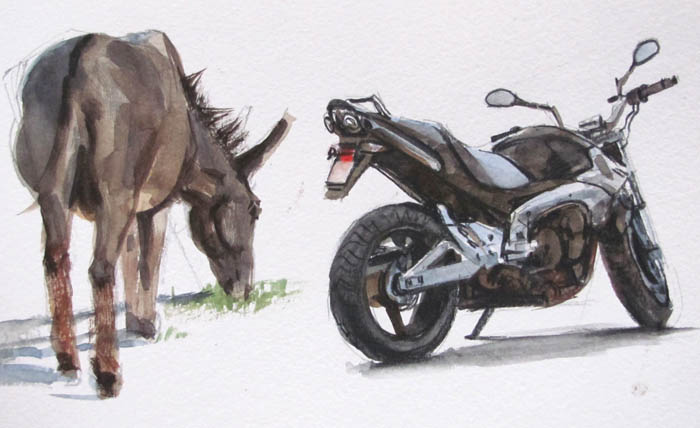
Peanut the donkey posed for me last evening after her munch of hay and her roll in the dust.

But the other donkey, Jezebel, wanted some attention too. She walked over and rested her heavy head on top of my sketchbook, wanting to be scratched on the top of her neck.

Thứ Năm, 29 tháng 7, 2010

“Hard Times” Exhibit

Note: Event tonight in New York City (see end of post)

“A portentous stillness hangs over America; the affluence that we thought
would last forever has been replaced with apprehension, angst and anxiety,” says Traci Fieldsted, curator of the exhibition.

Clockwise from upper left, "Artist's Mother," David Kassan, 30 x 20, oil on canvas; "Wall Poster, " Burton Silverman, 48 x 40, oil on canvas; "Homeless, " Max Ginsburg, oil on canvas, 25 x 40.

The show is called “Hard Times: An Artists’ View” (at the Salmagundi Club in New York through August 20). The subjects are homeless people, manual laborers, and street vendors.

Warren Chang’s “Fall Tilling” shows field workers toiling with hoes. A woman sits on the ground, while a man talks on his cellphone.

The fourteen artists in the group show include such veteran realists as Harvey Dinnerstein, Burton Silverman, and Max Ginsberg. According to a caption, they “weathered the drought imposed by the modern abstract art establishment.”

Max Ginsberg’s “Snapple” shows a hot dog stand with tattered umbrellas. The sign in the store behind says “CLOSING OUT INVENTORY: EVERYTHING MUST GO.”

The paintings steer clear of overt narrative, sentimental pity, or political diatribe. Unfortunately, some images look like professional models impersonating down-and-outers. And some rely a bit too heavily on photographs.

The most convincing is a street scene with African-American young people painted by Garin Baker. Mr. Baker knows the neighborhood well, because he has worked for years on the street, developed a mural program with underprivileged artists in Newburgh, NY.

Marvin Franklin (1952-2007) painted authoritative watercolors of subway riders. Franklin taught at the Art Students League, working night shifts as a track cleaner on the subway, where he was killed in a freak train accident.

The show presents a brave direction to young realist painters, something meaningful to express with their skills. It stand squarely in the nineteenth-century realist tradition of Bastien-Lepage, Kramskoi (above: "Portrait of a Peasant"), and Dagnan-Bouveret, as well as the better-known Courbet, Millet, and Van Gogh.

The images are disquieting, reminding us of the hardships faced by the bottom margin of our society. Art can make us look at things we’d normally look away from. Such subjects are not easy choices for a career-minded painter. They are often made at the expense of an automatic sale.

Tonight there will be a lecture and panel discussion at the Salmagundi Club, including Fred Ross, Vern G. Swanson, Peter Trippi, Harvey Dinnerstein, and Burton Silverman.

Panel Discussion at the Salmagundi Club in New York City TONIGHT at 7:00 p.m. with a reception following
Art Renewal Center Article about the Exhibit

Warren Chang's Website
Max Ginsberg's Website
Garin Baker, Carriage House Studios
Salmagundi Club is at 47 Fifth Avenue New York, NY 10003
Hours: Monday - Friday 1:00 - 6:00 PM Weekends 1:00-5:00 PM

Thứ Tư, 28 tháng 7, 2010

Restoring Art Programs

Comic art legend Joe Sinnott grew up in Saugerties, New York. At age 83, he still lives there and he still works for Marvel.

When the Saugerties school board decided to cancel the art program, he wrote a letter describing how he owes his career to the encouragement of art teachers.

“I know that today it’s much harder to get into art schools and colleges, and that it is a necessity to have high school art credits to apply to these schools. The creativity starts in the early years, and I have lectured for the children at Riccardi, Cahill, Grant D. Morse and Saugerties High School to enthusiastic students. …Art is not just a fun subject. It is a career choice for many. Without it, many talents will be wasted.”


Joe Sinnott’s entire letter.
Report on hopes to restore the art program at the Sauguerties School District
Image from Wizard's Keep, which has more art and a bio of Joe Sinnott.