Thứ Bảy, 9 tháng 10, 2010

Hatt’s Color Book

Just before my book, “Color and Light: A Guide for the Realist Painter,” was about to go to press last June, I happened to stop by a secondhand book shop and noticed a book on the shelf called “The Colorist,” by J. A. H. Hatt.


Here was a title I had never heard of before. The date of the book was 1908. What really grabbed me was the subtitle: “Designed to Correct the Commonly Held Theory that Red, Yellow, and Blue are the Primary Colors, and to Supply the Much Needed Easy Method of Determining Color Harmony.”


I bought the book, brought it home, read it, and was thunderstruck. Here was the very same theory that I’ve been developing on my own, and which I thought was new and revolutionary.

In essence, Hatt’s premise is exactly the same as mine: instead thinking of red, yellow, and blue as the primary colors, we should be replacing them with magenta, yellow, and cyan. (Note that what he calls "violet" is the same as what I call "blue" on the Yurmby wheel. The difference is a matter of semantics, and we're both talking about a kind of violet-blue.)

Anyway, printers in Hatt's day were just discovering this new was of thinking of the color wheel. They made the switch then and never looked back.

Magenta was a new color to the world of printing in Hatt’s day. He was acquainted with the chemist who developed one of the first formulations for magenta ink, and he warned readers of the book not to hold the pages open too long to sunlight, or the rare ink would fade.


The second novelty of Hatt’s book is his method for developing color harmonies, using templates laid over a gradating color wheel. This also was a lot like the system I had struck upon independently, but instead of graying the color wheel at the center, his went to white in the middle, and carried dark tones in outer rings.

And according to the text of the book, there were supposed to be gamut masks or templates in the back of the book, but unfortunately, they were missing in my copy.

(My own work in the area of gamut masking owes much to Walter Sargent’s 1923 book, “The Enjoyment and Use of Color,” reprinted by Dover). Link to Amazon for Sargent's book here.

So what’s new is old, I guess. Anyway, you can read Hatt’s book yourself on a free downloadable PDF courtesy of Google Books.
------
--My book, due out in November, is: Color and Light: A Guide for the Realist Painter 
 --Wikipedia gives a good overview of the history of thinking about primaries
--And so does Bruce MacEvoy in Handprint.com
--(added) And David Briggs on HueValueChroma
--Previously on GurneyJourney (Feb 2010): Rethinking the Color Wheel 
--If you live in the Pasadena, California area, please come to my workshop tomorrow, Sunday, that covers this stuff.

Thứ Sáu, 8 tháng 10, 2010

DreamWorks Dream Team

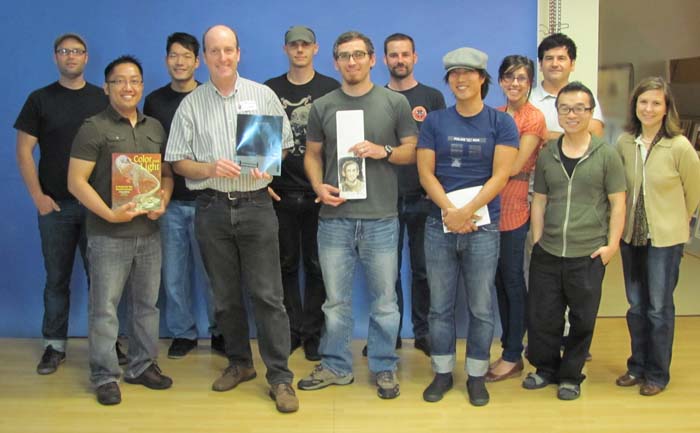
DreamWorks Animation has an elite group of concept artists divided between its two campuses in California. I visited with the dream team at the Redwood City campus to share my presentation about color and light---and to show the panda a few kung fu moves.


 We then went upstairs to their very inspiring creative habitat. When they're not working on new character designs and environments for movies like Puss in Boots, The Croods, Kung Fu Panda: The Kaboom of Doom and Megamind, they have an art room for figure drawing classes.


Ruben Perez is holding a demo sketch I did of him using water-soluble colored pencils. And we're holding each others' one-of-a-kind advance copies of upcoming books: Color and Light: A Guide for the Realist Painter, and Moonshine: DreamWorks Artists...After Dark.

That "Moonshine" book, which should arrive in stores soon, showcases the personal work, done after hours, by each member of DreamWorks's creative crew.
--------
DreamWorks Animation SKG
Moonshine at Amazon
Thanks, Angela, Katie, and the awesome DW Team!


Thứ Năm, 7 tháng 10, 2010

Overlaid Wash Test

Here’s a chart of watercolor pigment combinations. The purpose of the exercise is to see how colors interact when they’re superimposed, rather than mixed wet. After one color swatch is painted and allowed to dry, a second color is laid over it.

The starting colors, on the diagonal from lower left to upper right, are: Winsor yellow, Winsor red, permanent alizarin crimson, ultramarine blue, cerulean blue, and Winsor green. Each possible mixture sits at the intersection of a horizontal row and a vertical column.

The arrow, for example, shows a combination of permanent alizarin crimson and ultramarine blue. Farther to the right, the mixture of Winsor green and alizarin crimson makes a beautiful gray whose component colors are still visible.

Thứ Tư, 6 tháng 10, 2010

Jahari the Lion

The lion house at the San Francisco Zoo opened at 1:00 yesterday, and I went in there to stare down a lion.

The lion's name is "Jahari," meaning "strong and brave." The seven-year-old weighs 550 pounds, one of the largest lions in captivity.

According to his trainer, Debbie Marrin-Towey, he likes the game of intimidating visitors. He was hand-raised, fed by a bottle as a cub, so he is particularly fascinated by humans.

Ms. Marrin-Towey told me it was time for Jahari's snack. She checked that all the doors were securely locked, and then sprayed some milk on a dead rabbit and placed it in his outdoor enclosure. Jahari's eyes stopped watching the nervous movements of my watercolor pencils, and followed her instead.

After what happened here three years ago, I'm glad the cage was well secured.
-------
2007 fatal tiger attack
San Franciso Zoo
Previously on GJ: Gorilla Portraits

Thứ Ba, 5 tháng 10, 2010

Drawing Models

J. D. Harding wrote a book way back in 1854 that still has solid-gold advice for art and architecture students today.

He suggested making models of architecture to use as drawing subjects.

They teach you perspective and light and shade in a way that nothing else can. The geometric forms are a good supplement to the organic shapes of figure and cast drawing.

The book shows roof plans for various grand estates. If you’ve got a wood shop, you can cut all the various architectural pieces out of larger pieces of wood. The model pieces also make great blocks for kids to build with. Nowadays you could also use build them out of cardboard or foam core board, or cut them out of a dense foam.

His book, “Drawing Models and Their Uses” is available as a free download from Google Books.
-------
Drawing Models and Their Uses from Google Books (click the "Download PDF" button at the right side of the page)

Thứ Hai, 4 tháng 10, 2010

Water by Three Masters

Here is a section of water as painted by three different artists. Can you name them?

(Addendum: "Florante" guessed it: Joaquin Sorolla, Anders Zorn, and John Singer Sargent)

The fact that many of you can identify them—even if you haven’t seen these specific paintings—is proof that we cannot escape our own handwriting. But it’s not just the “mark-making” at work here. Nor it it about style. It’s the seeing, the understanding, that separates each of these artists.

While each of these painters was a sensitive and close observer, each captured different qualities of water’s infinitely variable and elusive nature. The one on the left is interested in the upward-facing crescent shapes of the wavelets. The one in the middle features the soft transitions of the central ripples in contrast to the hard transitions and arabesques of the reflections. The one on the right is fascinated by the riot of color that shows up in illuminated shallow water, and the simultaneous transparency and reflectivity.

Even if these artists were standing side by side earnestly trying to accurately capture the same exact view, you’d still be able to pick out each individual. That’s why I believe it’s mistaken to believe that the pursuit of realism necessarily leads to sameness. Those who describe realism as slavish imitation miss this point. One artist’s paintings can be true to nature but emphasize different aspects of visual truth compared to another artist. The way you paint is a record of how you see.
--------
Related GJ post: Reflections of Masts on Rippled Water.
Color in Mountain Streams

Italian Exhibition

Journey into the World of Gurney: from Chandara to Ancient Egypt.
---
Lucca, Italy at the Palazzo Ducale
Lucca Comics & Games, October 16, 2010 through November 1, 2010
---
A few days ago, a truck came and took away two big crates of artwork bound for Italy. The artwork will be featured in an exhibition of approximately 40 of my paintings.

The show begins with Dinotopia: Journey to Chandara, showing both the private and public lives of humans and dinosaurs, and exploring the intersection of utopia, geography, history, science, and fantasy.

Visitors will also be treated to few paintings from Dinotopia: The World Beneath which have never before been exhibited. The exhibit concludes with additional original oil paintings from the world of science fiction and fantasy paperback covers, as well as historical paintings for National Geographic (Voyage of Jason, above, will be included).

For any further information:
Lucca Comics and Games 2010
Also includes image from previous post: Kushite King

Chủ Nhật, 3 tháng 10, 2010

Ionic Jeep

I think it’s really cool that the Jeep car company chose a Greek Ionic capital as the symbol printed on their spare tire cover.

It lends an air of dignity and refinement to the brand. I can’t help but think of Plato and Aristotle bouncing along in an off-road chariot.

Previously: “Stormtrooper Doughboy

Thứ Bảy, 2 tháng 10, 2010

How Ink is Made


This eight-minute documentary shows how they make commercial printing ink. The colors and textures are so delicious that you’ll want to eat them.

Thứ Sáu, 1 tháng 10, 2010

Chromatic Shadows, Part 2

As we saw yesterday, adjacent colored light sources result in overlapping colored shadows.

Here’s another rule of thumb: If you have two light sources of different colors shining on the same form, the cast shadow from each light source will be the color of the other source.

That’s because each colored light shines into the shadow of the other. So when the amber light shines on the cylinder, it casts a shadow that is filled only by the blue light—hence the blue shadow.

Let’s make the scenario even more challenging: What happens to the shadows when you have three colored sources? Here’s the effect from blue, red, and green lights.

Note that the cast shadows behind my raised hand and my head are magenta, cyan, and yellow. The yellow shadow on the far right is cast by the blue light. It’s yellow because it is lit by a mixture of green and red. In the realm of light, as opposed to pigment, green and red mix to make yellow.

The bright cyan shadow is cast by the central red light. It’s cyan because it contains the blend of blue and green light. Blue and green light mix to make cyan.

If you’re intrigued by colored light interactions, I’d recommend going to the home improvement or theater lighting store and picking up red, green, and blue lightbulbs that you can put in three different light sockets. The best way to learn this stuff is to set them up and try all sorts of combinations. I took the photo in the New York Hall of Science, which has an interactive setup installed.
--------
Related GJ post:
Colored Light and Form

Thứ Năm, 30 tháng 9, 2010

Chromatic Shadows, Part 1

The painting below shows a warrior standing on a ledge. He is lit by a slanting bar of light that shines from below.

Note that the cast shadow from his arm is red on the bottom and blue above.

The colored shadows suggest that the scene is lit by two adjacent spotlights, a red one below and a blue one above. This is typical of theater lighting, where two or more colored spotlights cast shadows with chromatic edges.

Tomorrow we’ll take a closer look at chromatic shadows.
-------
I painted the image for "Witches of Kregen," 1985, Daw Books. The painting will also appear in Color and Light.

October 18 Lecture in Phoenix

Here's an announcement for an upcoming lecture at the Art Institute in Phoenix, Arizona. It's open to all at no cost. Click on the image to enlarge.

Thứ Tư, 29 tháng 9, 2010

Talking Raven


If ravens can talk like this, imagine what dinosaurs could do.
Via Best of YouTube

L-ptop Dis-ste-

OK, I admit it, I was pretty stupid. I shouldn’t have been sipping tea near my MacBook laptop. It was even more foolish to spill half a cup of Irish Breakfast into the keyboard.

The tea sank down into the cracks. I turned it upside down and let some of it drip out. Then I tried drying it out with a hair dryer. I shot hot air through a FedEx envelope to force hot air into the vents.

Then I stood it up in front of the fireplace—never mind that it was 80 degrees outside. After a day of drying it out, I powered it up. The screen flickered a few times and then lit up.

The good news is that the moisture apparently didn’t get into the logic circuits. No files have been lost.

The bad news is that the “A,” “R,” and “F” keys don’t work anymore.

It’s h--d to come up with blog post without using those lette-s. They show up in -lmost -nything you t-y to wite. Dogs c-n s-y “bow-wow” -nd “woo-” but not “---.” Whe-e does Sh-ek live? The L-nd o- ---, ---, -w-y!”

I’ve ordered a new MacBook Pro. My makeshift solution with the old one is to put an old G3 keyboard right over the laptop keyboard, and I’m more or less back in business.

I still drink tea, but I park it farther away.

Thứ Ba, 28 tháng 9, 2010

First Human Powered Ornithopter


Engineers have succeeded in a short sustained flight by an ultra-lightweight human-powered ornithopter. Instead of using a propellor, the machine propels itself by powered undulations of the wing.

Previously on GJ:
Insect Vehicles
Butterfly Flight Mechanics
Ornithopter Zone
YouTube video of machine-powered "UTIAS" ornithopter

Step-by-Step in International Artist

The new October/ November issue of International Artist magazine has a four-page feature on the making of the painting “Old Conductor” for Dinotopia: Journey to Chandara.

The reproduction of the various steps are shown larger and in more detail than what appears in Imaginative Realism, and I included some of the reference photos.

This issue has other step-by-step demos, including an alla prima oil portrait by Tony Pro. “The Art of the Portrait,” a regular feature of the magazine by Gordon Whetmore, shares news about artists such as Jeremy Lipking, Michael Shane Neal, and Everett Raymond Kinstler.
------
International Artist magazine
Previously on GJ: the Washin Stage

Thứ Hai, 27 tháng 9, 2010

Panel Roo

Jason Daniel Jackson has come up with a simple and lightweight way to store wet oil panels, two at a time.

It's called "PanelRoo," and it's made of wood molding with four spring clips on each face, which hold each painting facing into the middle. They're available in most standard sizes on his website, but he can also make custom sizes.

PanelRoo
Jason Daniel Jackson

Chủ Nhật, 26 tháng 9, 2010

Maker Faire: New York 2010

At the New York Science Center yesterday we visited the first annual MakerFaire, a celebration of the Do-It-Yourself movement.

At the Smooth-On sculpture products booth, I checked out a character made from “Dragon-Skin” silicon by Lone Wolf Effects.

If you sign the legal waiver, you can strap in and ride the Jet Ponies or Thundersteeds, a pulse-jet powered carousel. There was also a big-wheeled chariot and a motorcycle using the deafening fire-spitting jet technology.

There were bicycles dressed up as fish, as well as innovative recumbents and tricycles. One maker constructed giant beetle-like creatures using old inner tubes and used truck parts.

For the computer geeks, there were radio control robots, 3D printers, and tutorials on soldering simple circuits.

A range of traditional hand skills and child crafts were well represented. People of all ages were invited to learn knitting and crocheting with expert help. We saw a full size car covered in green fuzzy knitting.

The coalition of the handmade world embraces a wide range of people, from steampunk guys with hand-wound pocket watches, to goth princesses in gold spandex bikinis, to families led along by their awestruck grade schoolers.

A few large corporate players had a presence, such as Ford Motors, showing off its brand new 25 mpg Taurus Assault Vehicle. Martha Stewart’s organization had a slick living room set decorated with fake bones that you could make out of paper maché for Halloween.

At the close of the day, Make magazine editor and BoingBoing founder Mark Frauenfelder gave an illustrated talk on his personal odyssey to raise chickens and vegetables, carve wooden spoons, and build guitars out of cigar boxes, an experience he chronicles in his book “Made By Hand.”

It’s a striking irony that the faire takes place at the epicenter of both the 1939 and the 1964 World’s Fairs. You can look up from the tents and booths to the tawdry hulks of yesterday’s fading vision of the future, a vision that included a prosperous industrial America with gleaming flying cars and moving sidewalks. If Maker Faire is a glimpse of the future, it will be more like a computerized medieval marketplace.

The faire continues through today at the New York Hall of Science,
------
Maker Faire New York website
Make magazine
New York Hall of Science
Mark F’s book “Made by Hand: Searching for Meaning in a Throwaway World.”
YouTube video of Jet Ponies or Thundersteeds
Smooth-on sculpting products

Folded and Gathered

The unbound proofs of Color and Light have just arrived. These are the final pages, with all the folded and gathered signatures, but it’s not yet bound into the final softcover book. The production run is just finishing, and will soon be on a boat crossing the Pacific.

The book has over 300 color reproductions, with my plein air work more strongly represented than in Imaginative Realism.

The publisher, Andrews McMeel took great care with the reproduction, going through four rounds of color proofing, and reshooting a whole bunch of pieces to make them even better. I’m very excited with how it’s looking. We expect that the books will be in stores around the end of November.

Color and Light book

Thứ Sáu, 24 tháng 9, 2010

Turnip Cart

“Turnip Cart” is the last of three original oil paintings that will be offered for sale in the fantasy and comics auction in Paris on October 16.

It shows Bix walking alongside a Triceratops while Arthur Denison hitches a ride with a farmer named Ilya Shinshik. That last name is an anagram of “Shishkin,” one of the Russian painters who influenced the paintings published in Dinotopia: Journey to Chandara.

The painting also was reproduced in Imaginative Realism to illustrate the compositional device called “spokewheeling.”
-------
Emperors_Offer & Imperial Palace
Galerie Daniel Maghen is the expert adviser in the sale. For more information, please email Olivier Souille at "info@danielmaghen.com"
Tajan’s October bande dessinée auction (the final online catalog is still in preparation).
James Gurney Original Art blog
Dinotopia website
James Gurney Original Art blog
Dinotopia: Journey to Chandara

Thứ Năm, 23 tháng 9, 2010

How to Blog

Don't miss Issue 61 of ImagineFX magazine, which is on the newsstands. It has a free "Color and Light" poster inside previewing the upcoming book.

It also has a feature called "The Fine Art of Blogging," about IFX's pix for Five Great Art Blogs: Art Order, The Art Department, Drawnk, Charlie Bowater, and Knuckle Deep.

They asked me for my Seven Secrets of Blogging:

1. Keep things brief. 2. Employ a simple design. 3. Variety is the key (funny stories, obscure videos, geeky factoids and practical studio tips). 4. Try to stay positive. 5. Favor information over opinions. 6. Compose offline. 7. And look for those three things that always drive traffic: a well-framed debate, a bizarre true story, or a post entitled "How to..."

But I don't always follow my own advice. I composed this post in a Barnes and Noble.

Philip de László Paints Venice


Philip Alexius de László (18691937) was a dashing portrait painter of a hundred years ago, a contemporary of Sargent. In this video, narrated by his son, we can watch him paint a plein-air study of the bronze horses in Venice, while fending off the friendly ribbing of his wife. Clicking the "play" link takes you to American Artist Daily.
-------
Via Allison Malafronte of American Artist Daily.
Gallery of works at the de Laszlo Archive Trust
More about de Laszlo at JSS Gallery.org

Thứ Tư, 22 tháng 9, 2010

Atelier Marchant October 10


For those of you in the northern Los Angeles/ San Fernando Valley area, I'll be doing a three-part lecture series October 10th, 2010 from 1pm-5pm at the Atelier Marchant.

The lectures include "Imaginative Realism: How to Paint What Doesn't Exist" at 1:00, "Color and Light: Tools for Mood and Atmosphere" at 2:30 and "Plein Air Pioneers: Tradition and Technique" at 4:00.

The fee is $30 for each lecture or $65 for the entire day. Call 661.350.1579 or email marchantatelier@gmail.com to register.

Marchant Atelier Blog with more info.
Earlier GJ post about other upcoming workshops in California

Clouds: Growth and Dispersion

Clouds have a life cycle. They grow and they decay. We don’t really perceive the process because it happens so slowly.

If you speed up the action, you can see the growth side of the equation as the clouds emerge in tight, convex cells.


Watch the top of the frame, and you can also see the dispersion. Clouds break into fragments, called “fractus” clouds, and then melt into the sky. Because the water vapor is less dense, fractus clouds are never as bright white as the growth cells.

Artist James Perry Wilson included both phases of a cloud’s life in this detail of a painted diorama backdrop at the Museum of Natural History in New York.
---------------
Fractus clouds on Wikipedia
Earlier GJ Posts: “Capturing a Cumulus”
"James Perry Wilson's Dioramas"

Thứ Ba, 21 tháng 9, 2010

Red Cube, Pink Cube

The chroma, or saturation, of a color should be carefully considered as an object transitions from light into shade. Making the shadow color too intense can create a false effect.

It’s a common mistake with beginning painters, who sometimes use pure tube colors for middle values and add white to lighten them and black to darken them.

The diagram is by Andrew Loomis, from his book Creative Illustration, still one of the best books on painting, color, and composition. Unfortunately it is out of print and expensive to obtain in its printed form.

But there’s good news: You can download a PDF copy of Creative Illustration and Loomis’s other books. They’re all well worth study.
--------
Loomis books from Illustration Island.com
Previously on GJ: Color Obtains in the Light
Thanks, Evan!

Thứ Hai, 20 tháng 9, 2010

Imperial Palace

The second of three original Dinotopia paintings for sale in the upcoming auction shows the Imperial Palace of the city of Chandara.

The view looks east across the Zhengtao River. The emperor’s palace occupies a high and remote prominence in the center of the city. Morning sunlight illuminates the top of the gold dome and the flying buttresses, while thunderclouds assemble over Silver Bay.

My approach was inspired by several artists of the past who specialized in otherworldly moods in landscape: Frederic Church, Isaac Levitan, Andreas Achenbach, Hans Gude, and Jean Ferdinand Monchablon.

The painting is in oil, and appeared in Dinotopia: Journey to Chandara, which was published in USA, France, Hungary, Romania, Bulgaria, Czech Republic, Greece. It also was published in Imaginative Realism: How to Paint What Doesn’t Exist. Other paintings from the book toured museums in Yverdon, Switzerland, Newcastle, England, and Nantes, France.
-------
Earlier post about another painting in the Tajan auction.
Galerie Daniel Maghen is the expert adviser in the sale. For more information, please email Olivier Souille at "info@danielmaghen.com"
Tajan’s October bande dessinée auction (the final online catalog is still in preparation).
James Gurney Original Art blog
Dinotopia website
James Gurney Original Art blog
Dinotopia: Journey to Chandara

Chủ Nhật, 19 tháng 9, 2010

Artistic License

I’ve been practicing art without a license—until now.

This Artistic License was made by Rick Allen of Duluth, a master wood engraver and hand printer. Each license has a unique number and makes three passes through the press, one for each color.

Rick Allen, Kenspeckle Letterpress
Thanks, Steve Gilzow

Thứ Bảy, 18 tháng 9, 2010

Steel Bashaw

A new illustrated fantasy story presents the fruit of 15 years of effort by Serbian/Dutch artist Petar Meseldžija.

The folktale, called “The Legend of Steel Bashaw,” presents heroes, maidens, horses, and dragons—all fairly familiar stuff—but Meseldžija puts a new spin on it. He uses thick-paint impressionism, based on his plein air studies, to convey mossy forests and gnarly creatures.

The scene of the two giants hunched over the fire of their cave kitchen is worth the $19.95 price tag. In a “making-of” afterword section, the artist shows his development sketches for the grotesque monsters. He says he “searched for inspiration among old people, beggars, drunkards, and even the mentally handicapped.”
------
More from Flesk Publications
Petar Meseldžija.
Amazon listing
Lines and Colors post.

Thứ Sáu, 17 tháng 9, 2010

Pencil Point Sculpture

Artist Dalton Ghetti has done some amazingly detailed sculptures from the tips of pencil points.

From Trendhunter

Wootton's Lost WW1 Journal

A sketchbook and journal from World War 1, forgotten for 90 years, has surfaced in an attic.

It records the wonders and horrors of battle experienced by Lieutenant Kenneth Wootton.

Full article on the Daily Mail. Thanks, K-tron!

John Collier

At his blog Underpaintings, Matthew Innis has assembled an extensive portfolio of the British academic painter John Collier, along with a biography.

Here is Collier’s take on Queen Guinevere going a Maying.
-------------
Link to Underpaintings.
Download a PDF of Collier's book "A Primer of Art," with his thoughts on anatomy, perspective, oil painting, and light and shade.


Thứ Năm, 16 tháng 9, 2010

Upcoming California Workshops

Two upcoming California workshops:

1. October 7, San Francisco
The Art Department, also known as TAD, is an art school—both online and actual—specializing in imaginative drawing and painting.

TAD's online program uses streaming technology to webcast to students in remote classroom "pods." The pods are in San Francisco, Kansas City, Richmond, Austin, and London. Orange County, San Diego, and Amsterdam will be starting pods in January, 2011.

I'll be at the San Francisco pod on Thursday, October 7, meeting with students in person. The live webcast will also be available to enrolled students in other locations, who will be able to ask questions and give feedback.

TAD is closely associated with ConceptArt.org. Founder Jason Manley did a nice introduction with a portfolio on ConceptArt here.

Enrollment has begun for the Jan 2011 semester with part time, full time, and single classes available, and that scholarships (full, half, or quarter rides) are available for students who apply now. Link for the classes.


2. October 15, Encinitas (near Carlsbad) California
Come join me for a special half-day workshop at the Watts Atelier, founded by academic master Jeff Watts. I’ll be offering an information-packed afternoon with two lectures and demos, and lots of discussion and Q and A.

Lectures include:
“Plein-Air Pioneers.” History and modern practice of plein air painting and sketching, with detailed illustrations of my oil, watercolor, and oil set-ups.


“Color and Light.”An hour-long illustrated talk covering the key concepts most useful for realistic painting. I'll have an advance copy of the new book, but sales copies may not be available quite yet.

Plus, a portrait demo using water-soluble colored pencil sketching and water brush technique.

The fee is $45.00. Space is limited and quickly filling, so be sure to sign up soon. Watts Atelier can be reached at (760) 753-5378.

Links:
The Art Department
Concept Art / James Gurney
Watts Atelier

Traffic Illusion

Vancouver is trying out the idea of using optical illusions instead of speed bumps to slow down traffic.


Good idea or bad idea? The commentator says: “It’s just kind of flattened out! Almost like it’s painted on the roadway! Wow!”

Via Best of YouTube

Thứ Tư, 15 tháng 9, 2010

Dinotopia Originals to be in Tajan Auction

Some of you have asked if original art from the Dinotopia books will ever be made available to collectors. For many years I’ve kept them off the market so that I can make them available for museum exhibitions.

Until now, no paintings from Dinotopia: The World Beneath, First Flight, or Journey to Chandara have ever been sold.

On October 16, the Tajan auction house in Paris will conduct their first-ever sale of bande dessinée, which includes comics and fantasy art. They have invited me to participate.

The auction will include three original oil paintings from Dinotopia: Journey to Chandara, (published as Dinotopia: Un Voyage À Chandara in French).

The first painting, from page 151, is called “The Emperor’s Offer.” It shows the main characters, Arthur and Bix, with the officials of Chandara. The image is 17.5 x 29.5 cm on a 25.5 x 38 cm acid-free board, and is signed lower right.

This painting is very special to me and I worked hard to capture that other-worldly light and mood.

I posed a variety of models, including myself and my wife, and used a maquette to work out the pale, glowing silhouette of Chandara in the distance.

I’ll show the other two paintings in later posts.
----------
Galerie Daniel Maghen is the expert adviser in the sale, which will also include Moebius, Bilal, Pratt, and Franquin.
Tajan’s October bande dessinée auction (the final online catalog is still in preparation).
James Gurney Original Art blog
Dinotopia website
For more information, please email Olivier Souille at "info@danielmaghen.com"

Thứ Ba, 14 tháng 9, 2010

Caricature and Likeness

If you want a portrait likeness, don’t paint exactly what you see.

John Singer Sargent certainly didn’t copy appearances, as this photo/painting comparison attests. He exaggerated the character of his subject, Coventry Patmore. Sargent made the neck longer, the hair fuller, the face bonier, and the mustache more “twirly.”

To be clear, the painting was done from life, not from the photo, but both date from the mid 1890s.

Patmore was so impressed with Sargent’s interpretation of him that he wrote: “He seems to me to be the greatest, not only of living English portrait painters, but of all English portrait painters; and to be thus invited to sit to him for my picture is among the most signal honours I have ever received.”
--------
From the book John Singer Sargent by Richard Ormond, 1970, figure 21 and 22. Thanks, Barry!

ADDENDUM: Don't miss the fascinating string of comments on the subject of sight-size practice.

Thứ Hai, 13 tháng 9, 2010

Plein Air Winners

Yesterday I had the privilege of announcing the winners of the North Bennington Plein Air Competition.

From left to right, they are Hiu Lai Chong of Maryland, Jane Ramsey of Pennsylvania, and Andrew Orr of Vermont.

Ramsey’s first-place watercolor, “Storm Watch” depicts the roofline of the barn that formerly served as the studio of painter Kenneth Nolan. It’s now part of the Taraden Bed and Breakfast, one of the hosts and sponsors of the event. The artful cropping gives a fresh revelation of a familiar motif, with cool reds and rust colors contrasting with the blue-greens of the slate shingles.

Orr won second place with “Breaking Light,” one of four landscapes he exhibited showing the Vermont countryside near the town of North Bennington. In the painting, the clouds come and go across the far hills, with a variety of crisp and soft edges. His adept handling of chiaroscuro—light-on-dark and dark-on-light—dramatizes the scene.

Chong’s third place oil “Yard Work” captures the close color harmonies in the train depot, with strong compositional lines leading into the design. She simplified what must have been an immense amount of detail of white gravel and cross ties in the foreground.

Congratulations to all who participated, and thanks to the organizers, sponsors, and volunteers who made this a very successful event.
-----
North Bennington Plein Air Competition
Taraden Bed and Breakfast
Post with lots of pictures on Mary Byrom's blog
Jane Ramsey
Andrew Orr
Hiu Lai Chong